
7 May 2026
Tonight, something historic happened - we passed a bill through the upper house that seeks to reduce the trauma our legal system causes to victim-survivors of sexual assault. This is the result of the incredible Your Reference Ain’t Relevant campaign, a campaign spearheaded by Harrison James and Jarad Grice to remove the use of so-called good character references to reduce the sentence of convicted sex offenders.
Abigail said:
I contribute to debate on the Crimes (Sentencing Procedure) Amendment (Good Character at Sentencing) Bill 2026 as The Greens' gendered violence spokesperson. I thank our justice spokesperson, Ms Sue Higginson, for her considered and expert contribution, as always.
Before I started in Parliament, seven years ago, I completely underestimated how personal political life can be. I reckon almost every member in this place has at some point or another—even when it is not intended—silenced this House with a contribution to debate that is deeply personal for them: a death of a loved one, a difficult childhood, a history of having been abused in a domestic relationship, a past or current health issue or the experience of a terrible injustice that has shaped who they are and, more importantly, the perspective they bring to their work in this place. In those moments of vulnerability, we see why an MP has taken a particular position on a bill, why they feel so strongly about the matter at hand, or even why proceedings have hit a nerve and caused them to react in the way they have.
In this place and in their role, members at times have to reveal to the world a great deal about themselves in order to contribute in an authentic, principled and understandable way to our democracy. So it was that I found myself, shortly after being elected to this place, revealing details about my own experiences as a victim-survivor of child sexual assault. In hindsight, I did not do that as well as I could. It was more cathartic than strategic at the time, and it caused hurt to my family, for which I am deeply sorry. But I do not regret doing it. I received many, many messages from other child sexual assault victim-survivors, both within and outside of Parliament, thanking me for bringing a victim-survivor's perspective to the halls of Parliament, and particularly to this place, where laws are made that are critical to the design and operation of our criminal and justice systems.
For victims of a sexual offence—let alone child victims—the criminal and justice systems are more likely to exacerbate their trauma than to provide any kind of resolution to the harm done to them. The obstacles to raising an incident, having it believed and having it investigated or prosecuted—let alone finally getting a guilty verdict—are simply enormous. Every single part of that process is gruelling and brutal. Then, for the few victim-survivors who have made it that far and had their perpetrator found guilty, they are faced with the possibility that that perpetrator's sentence could be reduced because of so-called good character references being presented. If you are a victim of sexual assault, expect to be cross-examined and have every aspect of your life put on trial. You do not get the benefit of people coming into the court to say how great you are, but your perpetrator does.
Many incredible advocates argue that for many crimes—particularly for sexual assault and domestic and family violence—our existing policing and justice systems are simply inappropriate to respond to the harm caused to victims of those offences. Think of the woman experiencing domestic abuse who just wants the abuse to stop. They do not want to leave their partner; they may love him deeply despite his behaviour. But they call the police and he is locked up, simply because they have no other assistance at hand to get him to stop. Or think of the victim of sexual assault who is bullied by their perpetrator with threats of defamation or is forced to sign a non-disclosure agreement, when all they really want is an acknowledgement that their perpetrator has done wrong, has caused them real harm, and needs to make reparations for what they have done and to assure their victim that they will never do what they did to them to any other person again.
The healing process for victim-survivors of those crimes is never simple, and the considerations behind why a perpetrator does what they do are complex. A perpetrator can themselves be a victim of abuse, mental health issues or terrible life circumstances, but none of that makes the harm done to their victim any less real. Not all victim-survivors want a response that sees their perpetrators locked up or harshly sentenced. But when they do, it can serve as part of the healing process to finally be believed and have it proven in a court of law that, yes, they were abused and it caused them real harm; yes, it was wrong, and their perpetrator should not have done that to them; and, yes, society as a whole will work to ensure that it does not happen to others.
For a victim-survivor, that restorative impact of sentencing goes out the window when someone stands up and says, "Yes, even though the perpetrator has been found guilty of sexually abusing a child, I personally think they are a great person except for that."
So it was that, when Harrison James and Jarad Grice came to see me about their Your Reference Ain't Relevant campaign, I was instantly convinced and compelled to do what I could to help them achieve that vitally important reform. Back in early 2023, Harri and Jarad reached out to me to discuss their Your Reference Ain't Relevant campaign, which was calling for so-called good character to no longer be considered relevant in any circumstances during the sentencing of convicted child sexual offenders.
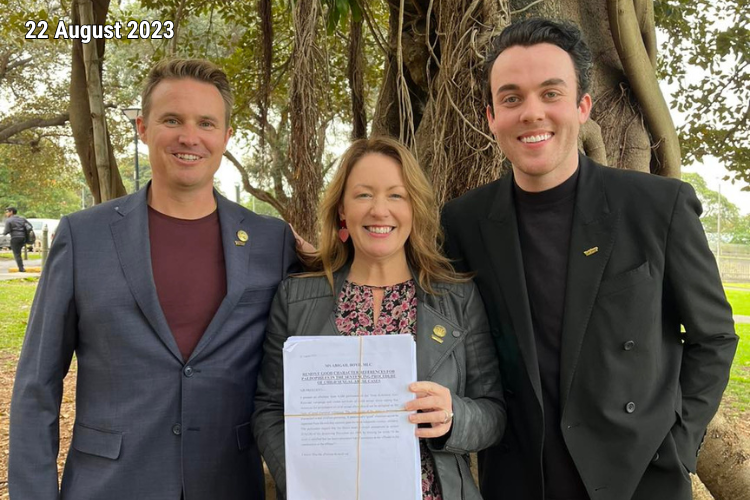
Harri has told me that they had knocked on 50 doors at that point, speaking to parliamentarians from all sides of politics, who all turned down their request to back the campaign. On 22 August 2023, I was proud and deeply honoured to table a petition on behalf of Harri, Jarad and the Your Reference Ain't Relevant campaign to the Legislative Council. The petition had received 4,340 signatures and called for a simple amendment to section 21A (5A) of the Crimes (Sentencing Procedure) Act 1999, by deleting the words "if the court is satisfied that the factor concerned was of assistance to the offender in the commission of the offence".
The petition affirmed that sentences for perpetrators of child sexual abuse should not be mitigated on the basis of good character references. The very nature of the crime is predatory, manipulative and involves grooming. A perpetrator's "good character" cannot be separated from the evil they commit against the most vulnerable victims: children.
The New South Wales Government tabled its response to our petition on 19 September 2023, with the Attorney General announcing that, because of the advocacy of the Your Reference Ain't Relevant campaign, the Department of Communities and Justice had been directed to undertake a review of section 21A (5A) of the Crimes (Sentencing Procedure) Act 1999 and the use of good character in child sexual offence matters.
The Attorney General advised that in conducting the review the department would consult victim‑survivors and victim‑survivor advocacy groups, along with legal stakeholders, on options for reform to improve the experiences and outcomes for victim‑survivors. This was a huge development in the campaign and the first of many to come. After months of delay and uncertainty surrounding the department's review, including the initial discussion paper being marked confidential and not widely circulated, in April 2024 the Attorney General directed the NSW Sentencing Council to review the legislation and the common law behind the use of good character to mitigate sentences. The Sentencing Council heard from stakeholders across various sectors, including victim‑survivors, advocates, legal experts and other experts, and engaged in consultation across several months before presenting its report to the Attorney General on 8 July 2025.
Since 2023, Harri and Jarad have travelled across the country, meeting with parliamentarians from all sides of politics, experts, advocates and other victim‑survivors to grow the campaign and inspire change across the country. Shortly after making their mark in New South Wales, Harri and Jarad took the campaign to the Australian Capital Territory, where they joined forces with my Greens colleague and then Attorney-General in the Territory, Shane Rattenbury. To quote Harrison's words from October 2023, "Our goal wasn't ever just to bring about change in New South Wales—it was to set a precedent that will resonate across all jurisdictions. Jarad and I want survivors in every corner of Australia to have access to the same rights and protections."
Harri and Jarad worked with our Greens colleagues in the Australian Capital Territory over the coming months and years to first table a petition in the Australian Capital Territory Legislative Assembly in early 2024, and then go on to eventually draft a landmark bill. In July 2024, the Your Reference Ain't Relevant campaign was officially discussed as an agenda item at the Standing Council of Attorneys-General meeting—another incredible milestone that marked yet another turning point in the campaign. That same month the campaign launched in South Australia, before making its way to Tasmania and Western Australia in October and then to Queensland in December 2024.
A year later, in December 2025, the Australian Capital Territory Government introduced historic legislation in its Legislative Assembly to totally abolish all good character references for convicted child sex offenders. This same month the Your Reference Ain't Relevant campaign officially grew beyond Australia's borders when Harri and Jarad partnered with survivor Sam Troth in New Zealand to take the campaign directly to the New Zealand Parliament. Two months later, in February 2026 and nearly three years after Harri and Jarad first reached out to my office, the New South Wales Government, alongside Harri and Jarad, announced it would introduce legislation to abolish good character references in sentencing. This sparked similar announcements by the Victorian Government and then the Tasmanian Government in the space of weeks.
I sincerely thank the Attorney General and the New South Wales Government for listening to the asks of victim‑survivors and for helping to make this campaign a reality, and to all parties who have supported it along the way. For child sex offences, in particular, this is an obvious reform. There has been a lot of focus in discussion on this reform around the trauma caused to victim‑survivors when these good character references are presented and read out, but this reform is much broader than that. The key here is in the name of the campaign: Your Reference Ain't Relevant. If a person has abused a child, the fact that other adults that person knows tell the court that in their experience it is out of character for that person—that that person is otherwise an upstanding member of society—is absolutely and completely irrelevant. Any suggestion that otherwise good people do not commit the most hideous crimes against children behind closed doors is one of the reasons these perpetrators can hide so easily in plain sight.
I cannot overstate just how damaging it is to perpetuate this idea that you can tell a child sex offender by how they present to the outside world. I spent so much of last year reading through horrendous reports of abuse and neglect in our early childhood sector. I had the privilege of meeting with people who are experts in what makes a paedophile tick. I had one of the most impactful dinners of my life talking to forensic psychologist Dr Michael Bourke. He has spent whole days and weeks interviewing individual paedophiles and serial killers—over a thousand of them—and the stories he told me and the warnings he gave me are seared across my mind for life. These paedophiles hide in plain sight. They may look like upstanding members of society in every other aspect of their life, but, frankly, that is completely irrelevant to what their character is like when it comes to why and how they choose to abuse children. We need to know that so we can be hypervigilant to protect our children from abuse before it occurs.
At the heart of our current laws is the outdated notion that what goes on inside the home or within personal relationships is of less concern to society as a whole than what occurs outside of the home. The objective of protecting the community from crime and deterring criminal behaviour has historically taken priority over other policing and sentencing objectives such as rehabilitation of offenders or seeking justice for victims. Nowhere is that more obvious than when it comes to the circumstances in which good character can be considered as a mitigating factor in sentencing offenders. By asking what a person's behaviour is ordinarily like in the eyes of the community at large, effectively, we are questioning what level of risk they pose to the community at large and, accordingly, how long their prison sentence should be.
Those crimes which are not personal in nature, and which typically occur outside of relationships, are the most obvious in which an offender's pre-offending conduct can be considered relevant—for example, a person convicted of shoplifting. In the context of that person's daily public life, their offence may validly be seen as out of character by others who have direct experience of that person's behaviour in similar contexts over a period of time. In that circumstance, maybe it is appropriate to say that person is actually a good person and they were just really hungry, and that is why they stole that food. However, that question cannot so validly be asked in relation to offences that occur in private or only in the context of certain relationships. We know now that it is common for otherwise upstanding citizens to commit child sexual assault. Many of them use their community reputation to get away with committing the crime in the first place. An entire royal commission explored how people managed to exploit and manipulate their social standing in order to gain access to vulnerable potential future victims.
By its very nature, a crime of sexual assault against a child ordinarily occurs in private, in a context that other people ordinarily interacting with the offender has no direct experience of. Unlike the crime of shoplifting, where a character reference might attest that the offender would not "normally do something like that", it is hard to imagine a character reference credibly stating that, in their direct experience, a particular child sexual assault offender would not normally abuse a child behind closed doors, or that they are a good person other than for the fact that they had committed this heinous act—as if we should have some kind of moral demerit points system for sexual abusers. It is on that basis we must look at the damage being done to victim-survivors and to the ability of our justice system to help and not further traumatise victim-survivors.
I extend my deepest gratitude and appreciation to Harri and Jarad. They are two incredibly passionate survivors, who have used their voices to fight relentlessly to change the laws that prevent victim-survivors of child sexual abuse from seeking justice. Since Harri and Jarad first reached out to me in the beginning of 2023, the Your Reference Ain't Relevant campaign has grown from strength to strength, stretching beyond New South Wales to nearly every State and Territory in Australia and even across the ocean to New Zealand in the past few months. It has been an honour to work alongside Harri and Jarad from the beginning and to watch their campaign grow, reach victim-survivors in countless communities and inspire change that will make a huge difference in the lives of victim-survivors everywhere. As I said in my submission to the department's review of the Your Reference Ain't Relevant campaign's ask in 2023, survivors and their experiences must be at the forefront of our justice system. That is exactly why Harri and Jarad's campaign has been so incredibly powerful in both its reach and in its impact.
I also add a more personal note. Being a victim of child sexual assault does not end. You do not wake up one day and think, "Oh, good. I have no ongoing trauma from that part of my life anymore." For those of us who are lucky enough to have accessed mental health support and who have supportive family and friends, we move to the victim-surviving part of our lives. With occasional triggers and setbacks, we are able to take that experience and use it to add to our power and agency, and not detract from it. But there are difficult days—really difficult days. There are days when people who should know better take our trauma and trample on it. I have had my experiences used for others' political gain by both sides of politics in this place. But in Harri I have always found a friend open to listening and providing solidarity—a fellow traveller in a world that can be incredibly cruel, but in which those who act with principles and courage can make real tangible improvements to the world around them. Harri is an inspiration to me and many others, and I am incredibly grateful to have worked with him so closely over the past three years. Harri should be so incredibly proud of all that he has achieved.
I look forward to seeing Harri and Jarad's campaign realised tonight, and I thank all parties for supporting reforms to remove so-called good character references from sexual assault cases.