
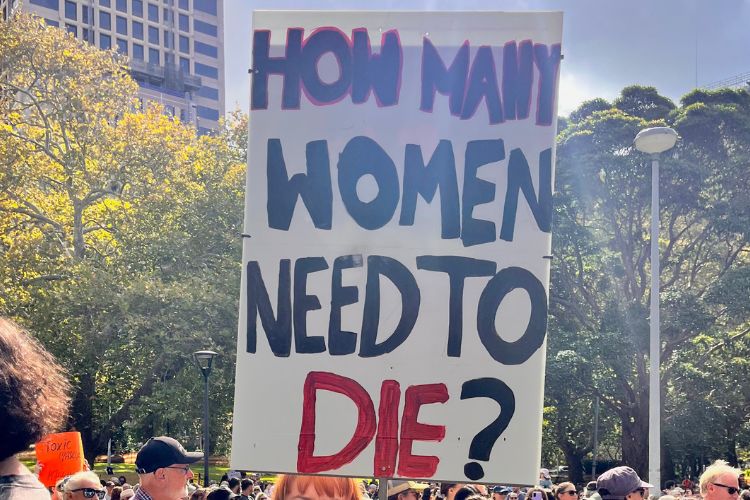
As NSW's deadly domestic violence record continues into 2026, Abigail passed a motion calling on the Minns Labor Government to urgently and properly commit to funding the domestic and family violence frontline.
Abigail said:
I move:
(1) That this House notes that:
- in the first month of 2026, six women were murdered in Australia, allegedly by men they knew, with two of those murders taking place in NSW;
- during the last week of January, three people were killed in Lake Cargelligo in an alleged domestic violence incident, including 24 year old Sophie Quinn, a pregnant First Nations woman, her 50 year old aunt Nerida Quinn and her 32 year old friend John Harris;
- First Nations women and children continue to be significantly over-represented in domestic and family violence statistics, experiencing higher rates of violence, serious injury and death than any other group in NSW;
- according to Domestic Violence NSW, for over a decade the NSW government has failed to properly invest in core funding for specialist frontline domestic and family violence services;
- frontline domestic and family violence services are reporting waitlist times of over eight weeks, some stretching for months on end;
- according to a recent report by DVNSW, the costs of delivering domestic and family violence services in regional, rural and remote communities is an estimated 8.94 times higher than in metropolitan communities; and
- in 2025, NSW once again recorded the highest rate of women murdered in a domestic and family violence context, according to Counting Dead Women Australia researchers of Destroy The Joint.
(2) That this House extends its deepest condolences to the families, loved ones and community of Central West NSW in the wake of these devastating murders.
(3) That this House calls on the NSW government to:
- heed the calls of experts to properly invest in the evidence-based prevention, response and recovery services and programs that prevent and respond to domestic and family violence incidents,
- commit to properly investing in the domestic and family violence frontline, by meeting the demands of Domestic Violence NSW for a minimum 50 percent increase in core funding for existing specialist domestic and family violence services;
- engage with First Nations communities to facilitate genuine truth-telling about the ongoing impacts of colonisation, systemic racism, intergenerational trauma and chronic under-investment in Aboriginal-led responses to domestic and family violence;
- ensure that adequate and additional funding for the domestic and family violence frontline is directed to Aboriginal-led, community-controlled solutions that are culturally safe and trauma-informed; and
- commit to providing a supplementary regional loading payment for regional, rural and remote domestic and family violence frontline services, to begin addressing the compounding barriers and rising demand facing these communities.
Year after year across the country, with little significant variation, we have seen at least one woman a week murdered as a result of gendered violence. Decade after decade, the rates of domestic and family violence incidents have not improved. Each domestic violence incident leaves in its wake families destroyed, victim-survivors living with debilitating emotional and physical scars, children growing up fearful and traumatised, perpetrators struggling under the weight of their own destruction, and parents losing everything that they thought mattered to them. The impact of this crisis is devastating, but it is also preventable.
When I first joined Parliament seven years ago and became The Greens NSW portfolio holder for the prevention of domestic and family violence, I set about learning everything I could from those with lived experience—from frontline workers, from advocacy bodies and from academics. I have been privileged to have worked with so many who have dedicated their time to research and developing policy. They have consulted, advocated, patiently explained and campaigned over decades. I am always in absolute awe of those people who work directly with victim-survivors of domestic and family violence. I have listened to their stories and their deep understanding of domestic and family violence matters, and I have listened to what they know is required to reduce the incidence of domestic and family violence in the communities they work in. They have been generous with sharing that expertise with everybody.
Over decades, the domestic and family violence sector has consistently advocated to government the evidence‑based services and programs needed to keep women and children safe. They have consistently advocated for all of the actions that they know are required if we are going to turn the domestic and family violence crisis around. Consistently at the top of that list has been the need for adequate funding for those frontline services whose availability can make the difference between life and death. People fleeing domestic and family violence—those who have made that often incredibly difficult decision to seek help—are at their most vulnerable. It can be disastrous if, in that moment, they are met with a closed door or an unanswered phone. But despite the best efforts of services across New South Wales, that is what is currently happening. In the past year alone, services have seen a large increase in new referrals—up 22 per cent—while funding constraints mean the number of clients they are able to support has barely changed and staff numbers have shrunk. As a consequence, growing numbers of victim‑survivors are unable to access the level of support they need to stay safe and escape violence.
Recent statistics from Domestic Violence NSW show that demand for frontline domestic and family violence services is so high that some services are supporting up to 900 per cent more victim-survivors than the New South Wales Government has provided funding for. The number of people on waitlists has doubled in the past year. Some services report waiting times exceeding 28 days. Services are experiencing significant periods of time when they are unable to answer the phone during their normal operating hours because of inadequate resourcing. Services are also reporting increasing complexity in the casework they do, which means the amount of time for which clients require case management or case coordination is becoming longer.
Specialist domestic and family violence services are going to extraordinary lengths to help victim‑survivors escape harm, even when they lack the capacity to provide the level of support needed. Some services are having to reduce support for existing clients to free up caseworkers for more urgent referrals, with staff often at breaking point in the face of increasing burnout, exhaustion and personal safety concerns, leading to experienced workers leaving the sector and major challenges in filling vacancies. To ensure that these services can keep operating, that their staff are not pushed to breaking point day after day and that the people seeking their help are not turned away, the New South Wales Labor Government needs to commit to a minimum 50 per cent increase in core funding for existing specialist domestic and family violence services. That has been a consistent demand from the sector year after year, but the Treasurer has refused to meet it. In fact, these services have not had an increase in their core funding for over a decade. We are not talking about huge amounts of money. In the grand scheme of things, that is around $170 million or 0.01 per cent of the New South Wales Government's budget.
Even if the Government remains stubbornly resistant to the idea of raising more revenue from obvious sources, like the super wealthy and big end of town, so many areas of spending could be redirected towards what should be a priority for this Government. Today we heard from the Auditor-General that in just the past three years this Government managed to lose a lazy $907 million behind the couch simply due to mismanaging major projects. We heard in estimates that the private schools are getting a $382 million subsidy every year just on payroll tax, let alone the rest they are not collecting in taxes like land tax. Budgets are about priorities, and they do show what the government of the day cares about. The Government cannot say it cares about women, children and all others harmed by domestic and family violence, and then fail to fund the number one thing that will keep them safer. Enough is enough. It is time to fund the front line.
Read the debate in Hansard here.
18 March 2026