
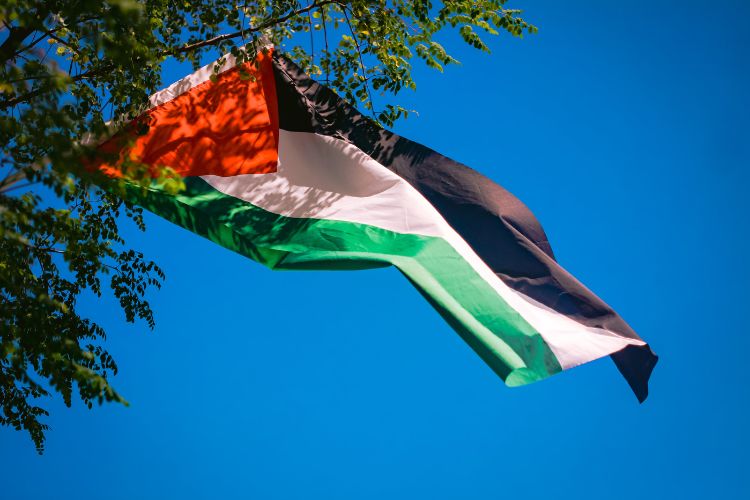
Today Abigail gave a motion recognising a landmark report by Australia Palestine Advocacy Network (APAN) about the alarming rise in anti-Palestinian racism in our education system.
Abigail said:
I give notice that on the next sitting day I will move:
(1) That this House notes that:
- the Australia Palestine Advocacy Network (APAN) published its National Register Report 2024–2025 entitled ‘Anti-Palestinian Racism in Australian Schools’ in September 2025, which compiles lived experiences submitted to the Anti-Palestinian Racism in Schools Register between March and July 2024 by teachers and education support staff in schools, parents, family members and family friends, and students within education communities;
- APAN reviewed 84 testimonies including lived experiences and witness accounts from the Palestinian diaspora and allies, and utilised research and theories that seek to understand settler colonialism and racism within education, to demonstrate not only how widespread this racism is, but how thoroughly it has been normalised in Australian educational settings;
-
APAN’s report details dozens of examples of anti-Palestinian racism reported by teachers, students and families, including:
- a Palestinian teacher who was prohibited from wearing their grandmother's keffiyeh by the school’s principal, after a parent had complained;
- multiple teachers who witnessed senior staff targeting students for wearing Palestinian flag pins;
- an educator who reported being directed by their principal to remove their Palestinian flag from a cultural diversity display on Harmony Day, despite that this principal had themselves placed an Israeli flag on the display;
- a student at Condell Park High School in NSW who was banned from attending their year 12 formal celebration because they wore a keffiyeh at their graduation ceremony;
- a Sydney teacher who was directed to stop wearing their keffiyeh on school themed days aimed at celebrating multiculturalism, despite that in previous years they had been explicitly encouraged to do so on school multicultural days; and
- an educator in NSW who was told by the school’s principal that photos of staff outside school hours could not appear on the social media page of NSW Teachers & School Staff for Palestine; and
-
APAN’s report found that:
- widespread and normalised anti-Palestinian racism exists within educational settings today, manifesting a climate of fear, censorship, intimidation and punishment experienced by students, teachers and school communities;
- anti-Palestinian racism is not a new phenomenon, and is rooted in the same colonial forms of oppression of First Nations peoples across the world;
- discussions of Palestine in schools are frequently repressed and censored, with teachers discouraged from expressing solidarity. “Neutrality” and “objectivity” are used as pedagogies of repression, leaving staff and students ‘fearful about engaging in important and open conversation’;
- Palestinian and non-Palestinian teachers, students and students’ families report being silenced, penalised and disciplined for expressions of Palestinian identity, culture and solidarity, including being reprimanded, having movement around schools restricted, being denied contracts and work, and having cultural symbols confiscated;
- Palestinian students and teachers report experiencing frequent and repeated racial violence and vilification, including being stereotyped as terrorists, inherently violent and deserving of violence;
- in NSW, the silencing of Palestinian perspectives in schools is a direct breach of the NSW Department of Education’s ‘Controversial Issues in Schools’ policy, which directs teachers to ensure sensitivity and balance in their presentation of controversial issues, stating teachers ‘should ensure that a range of views on a subject are taken into account in designing suitable learning programs’;
- staff and leaders in schools are openly breaching several policies and declarations by engaging in anti-Palestinian racism, and it is crucial that education departments introduce policies and guidelines that protect the rights of students, educators and education communities to explore the Gaza Genocide and to protect their right to be critical of the ways that the Australian state is complicit in this genocide; and
- education executives and leaders need to be held accountable to workplace regulations given reports of mistreating education sector workers and misusing the workplace relation to enforce state censorship and repression.
(2) That this House:
- affirms that anti-Palestinian racism has no place in NSW’s education system, and every person working or learning in our education system deserves to be safe, respected and supported; and
- commends the work of all those involved in the creation and release of APAN’s report, including Dr Ryan Al-Natour, Dr Sophie Rudolph, Dr Randa Abdel-Fattah, Dr Tasnim Mahmoud Sammak, Nasser Mashni, Nada Abdel-Fattah, Sara Saleh, Kaswar Ali and Nadeen Madkour.
(3) That this House calls on the NSW government to:
- acknowledge that anti-Palestinian racism is a significant and systemic issue within our education system;
- recognise the importance of diversity, inclusion and non-punitive approaches to addressing racism within educational settings; and
- commit to making our educational spaces places of critical inquiry, freedom of expression and empowerment for students and educators, by urgently addressing the drivers of anti-Palestinian racism and all forms of systemic oppression.
18 November 2025
Read APAN's report here: https://apan.org.au/wp-content/uploads/APR_Report_Digital.pdf