
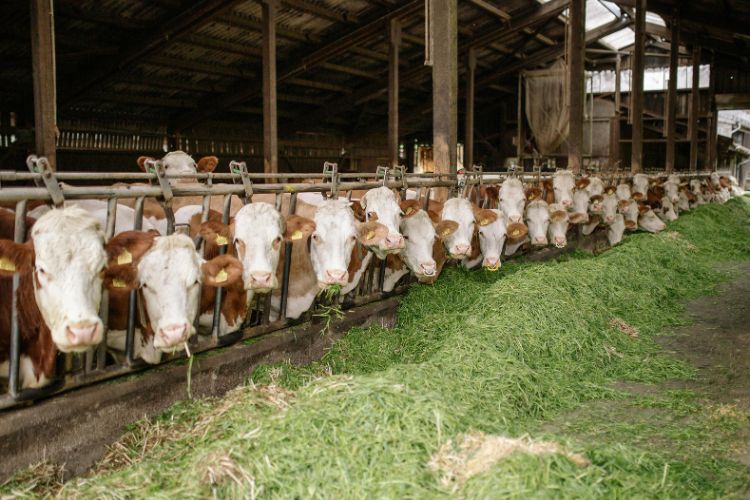
Today in Parliament, Abigail gave notice of a motion underscoring the true cost of animal agriculture and its devastating impact on the climate and our environment.
Abigail said:
I give notice that on the next sitting day I will move:
(1) That this House notes that:
- animal agriculture under global capitalism has become an international, industrialised market categorised by unsustainable growth, exploitation and the pursuit of low-cost production;
- intensive animal agriculture is one of the greatest threats to our living planet, and a driving force behind global warming, extensive biodiversity loss, large-scale deforestation, species extinction, water depletion, soil degradation and ocean dead zones;
- approximately 700 million animals are slaughtered for food every year in Australia, including 645 million chickens, 30 million sheep, 5.5 million cows and 5.5 million pigs;
- agriculture accounts for around 18 per cent of Australia’s total climate pollution and is the third largest source of greenhouse gas emissions after the energy and transport sectors, with the primary source of these emissions being methane from livestock enteric fermentation and methane and nitrous oxide from manure management, according to the Department of Climate Change, Energy, the Environment and Water (DCCEEW);
- agricultural production accounts for 57 per cent of Australia’s total land mass, 87 per cent of which is for livestock grazing, according to the Australian Bureau of Agricultural and Resource Economics and Sciences;
- the agriculture sector in NSW contributes around 17 per cent of the state’s total emissions, with enteric methane from ruminant livestock and manure management alone being the largest source at 70 per cent, according to the most recent data from DCCEEW;
- agriculture remains the biggest driver of land clearing in NSW, accounting for 77 per cent of all clearing in 2023 or 51,201 hectares, with land cleared for livestock grazing and crops for feed the primary driver, according to the latest NSW Statewide Landcover and Tree Study (SLATS);
- agriculture accounts for 70 per cent of global freshwater withdrawals, and animal products, particularly beef and dairy, have some of the highest water footprints of any food, according to the United Nations World Water Development Report;
- major gaps exist in data collection of the activities of animal agribusinesses, making it challenging to quantify their true climate, biodiversity and environmental impacts and monitor emissions reductions from this industry;
-
according to the Commonwealth Scientific and Industrial Research Organisation (CSIRO):
- global methane emissions have increased by 20 per cent in the last 20 years;
- livestock enteric fermentation and manure management is the greatest contributor of global methane emissions; and
- for net-zero emission pathways consistent with the Paris Agreement, which is stabilising temperatures below 2°C from pre-industrial levels, anthropogenic methane emissions need to decline by 45 per cent by 2050, relative to 2019 levels;
- Australia signed the Global Methane Pledge in October 2022, committing to reducing agriculture sector methane emissions by 30 per cent by 2030;
- the NSW government’s Primary Industries Climate Change Research Strategy, which ran from 2018 to 2023, noted that “reducing the emissions intensity of agricultural systems will be important in achieving the NSW Government’s aspirational target of net-zero emissions by 2050, as agricultural emissions account for 13 per cent of NSW greenhouse gas emissions. By reducing emissions across these areas, the primary industries sector has an opportunity to be a major contributor to achieving the State target”;
- the NSW government’s efforts to reduce agricultural emissions in recent years have included abatement programs, initiatives supporting farmers and land managers and other largely ad hoc programs that fail to comprehensively address the disproportionate climate, biodiversity and environmental impacts of intensive animal agriculture; and
- the Net Zero Commission has warned that NSW is not on track to meet its legislated emissions reduction targets for 2030 and 2035, and in its 2024 Annual Report the Commission highlighted that “the agriculture sector is expected to be the largest source of residual emissions in 2050 in the absence of technology breakthroughs or significant shifts in production”.
(2) That this House calls on the NSW government to commit to developing a sector wide plan which addresses the climate, biodiversity and environmental impacts of animal agriculture and lays out a pathway to reduce emissions from animal agriculture in alignment with the state’s net zero targets.
17 March 2026