
Today in Parliament, Abigail contributed to a debate on an affordable housing bill, slamming the NSW Government’s refusal to adopt minimum accessibility standards as a failure of political will and making clear that the real challenge isn’t reform, but the constant exclusion and indignity faced by people with disability in a society that continues to ignore their most basic needs.
Abigail said:
It is true that other States have signed up and have different implementations for minimum accessibility standards, but at least they signed up. To hide behind that and say that other States have done a bit more than us but have not gone as far as some of the other States and so therefore New South Wales does not have to do anything is really frustrating. At least the other States said, "This might be hard, it might be difficult, but we are going to give it a go. We will sign up and give it a red hot go to see how far we get." There have been difficulties, and I referred to some before. Certain classes of property are easier than others. They have had to put some exemptions in for some. In some places they have asked the developers and the building companies to start off by at least putting in, for example, the bigger corridors, and the reinforced items can be done later. They have started the process and tried to work out how to do it. We have not even done that.
When it comes to the definition of accessibility, I agree that it is not just about whether it fits this standard or that standard. A great group of people have been trying to get Domain to have a tick-a-box not only for pools or bedrooms but also for accessible corridors or levelled entrances and those kinds of things so that it is clear. People with disability are not a homogenous group—they all have different needs—so some things might not be fully accessible in accordance with one type of definition but still be acceptable. No-one said it will be easy to capture that information, but if we have housing providers that say to the Government they are putting a house on the affordable housing register that has three or four items of mobility or accessibility—or whatever it happens to be—I cannot believe we cannot design a system to capture that.
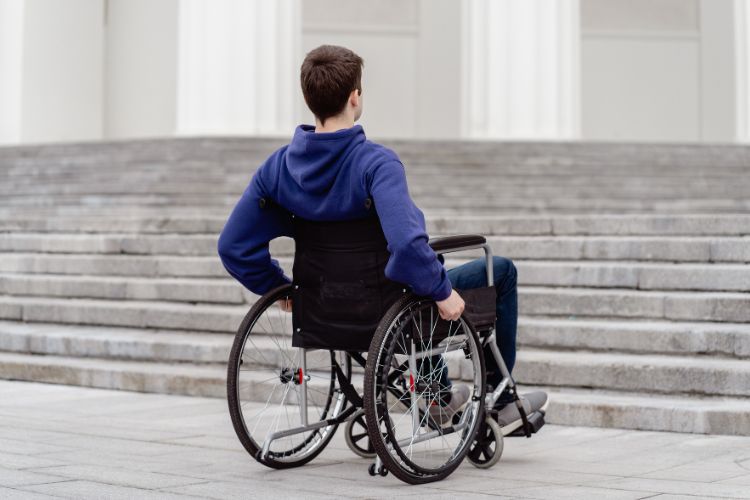
These things always have to be put in context. The bureaucracy might say that it is a bit hard to implement standards for new builds or to put this information on a register. But what is hard is being a person in a wheelchair unable to get into a house. That is actually hard. What is hard is going to a train station and finding the accessible bathroom closed that day and having to go two stations north and then one south in order to go to the toilet. That is hard. Living in a society that is not set up for people with mobility needs, that blocks them at every stage of their day—not knowing whether they will be allowed into a particular place or allowed to travel in a particular way that the rest of us take for granted—is hard.
When people who are facing that every single day in every single place are saying to this Government, "Please, we know it might not be straightforward, but it is not impossible," the Government could at least prioritise something as straightforward as putting those sorts of accessibility indicators into its affordable housing register. Housing also needs to be affordable for people with mobility needs, who make up up to 20 per cent of the population. That includes people who are ageing as well as people who have a mobility disability. The idea that we are only interested in providing affordable housing, or knowing where affordable housing is, for 80 per cent of people is not good enough.
I talk a lot about ableism in this place. It is not deliberate, but a lot of our institutions and the way that we go about doing things in government is quite ableist. To not be ableist requires actually saying, "We are going to do that hard thing, because it is important to other people who are having to do a much harder thing every single day." I ask the Minister to think carefully about how this could be done and to come up with innovative ways for including all people within the remit of providing affordable housing. People with disability are getting more fed up of being left behind in a country that just does not consider them.
Abigail moved several amendments to the bill to include accessibility measures, which were all unfortunately negatived.
Read the transcript in Hansard here.
24 June 2026